Mad/Not Mad
by Brian Quincy Newcomb
What would you do if you
were a Christian musician who didn't feel that it was your time to be
out playing, but you had all these synthesizers, sampling keyboards,
drum machines, and recording equipment in your basement? And what if
your favorite music was a type of music that no other Christian band
was playing and you had a real vision to make music that satisfied
Christians with tastes like your own yet reached another whole segment
of mainstream music fans with the gospel? Well, if you were Roger Rose,
you might create Mad at the World, write all the songs, play all the
instruments, and produce an album of the same name. That's exactly what
he did, and his album was recently released on Frontline Records.
"I personally know plenty of
people -- Christians -- who listen primarily to mainstream music
because Christian music does not satisfy them musically," says
Rose. "What Mad at the World is about is music that fills that kind of
void, yet I feel it is lyrically uncompromising in its Christian
message and values."
Although astute listeners
can detect the influences of Ultravox and Tears for Fears on the music
of MATW, clearly Rose is most affected by the sounds and philosophy of
Depeche Mode. While the group's music has deeply impacted Rose's, he is
often repelled by songs like "Blasphemous Rumours" and albums like Black
Celebration. Rose explains, "Depeche Mode is probably my favorite
group musically, but lyrically they are the most offensive, so dark and
terribly depressing."
Rose responds to these
discrepancies by writing directly to the untruths which might be
affecting youthful listeners. In the song "Dry Your Tears," for
instance, Rose describes "a world where you see nothing everywhere" (an
expression of the nihilism found in many a Depeche Mode lyric) before
expressing his own hope with "Close your eyes and pray/ Heaven could be
calling your name."
"I write things lyrically,"
affirms Rose, "that are undeniably Christian but seem to be easy
concepts to accept or grasp from a secular standpoint. Although I work
at subtlety, it's also just another way of expressing the truth that if
you love your possessions or your girlfriend or anything on this earth
more than God, then the result is death. That is an important message
for Christians to bear in mind as well as something to be shared with
unbelievers."
Rose's attempts to avoid
church talk and cliche result in some fresh, invigorating images. In
"Living Dead," the line "I need life blood" is, Rose suggests, "another
way of getting at Jesus' words that we need to be born again" without
using those now too familiar words. "Taking the Easy Way Out" actually
suggests that it is the voice of the Evil One that offers suicide as a
way of ending the pain of life when it really "isn't the easy way out."
Like Depeche Mode and other
bands of the techno-pop world, Mad at the World will be out on the road
this year without a drummer. Like the aforementioned band, essential
kick and snare sounds will be programmed into the computer while Rose,
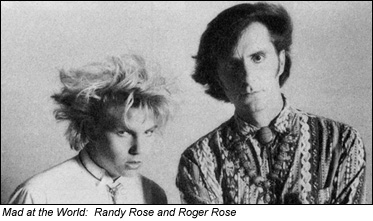
backed by 15-year-old brother Randy Rose playing percussion and sampled
sounds and Mike Pendleton on various keyboards, will sing, play
guitars, and add occasional synths.
Rose is excited about the
new record, its impressive cover art by Frontline's Ed McTaggart, and
talk at the label about marketing to college radio and reaching
mainstream listeners. Right now, though, he's thinking more about
touring and work on the next record. After all, Roger Rose is not just
upset -- he's Mad at the World.
|